Tattoo Identification for Livestock: Permanent Marks That Survive Decades
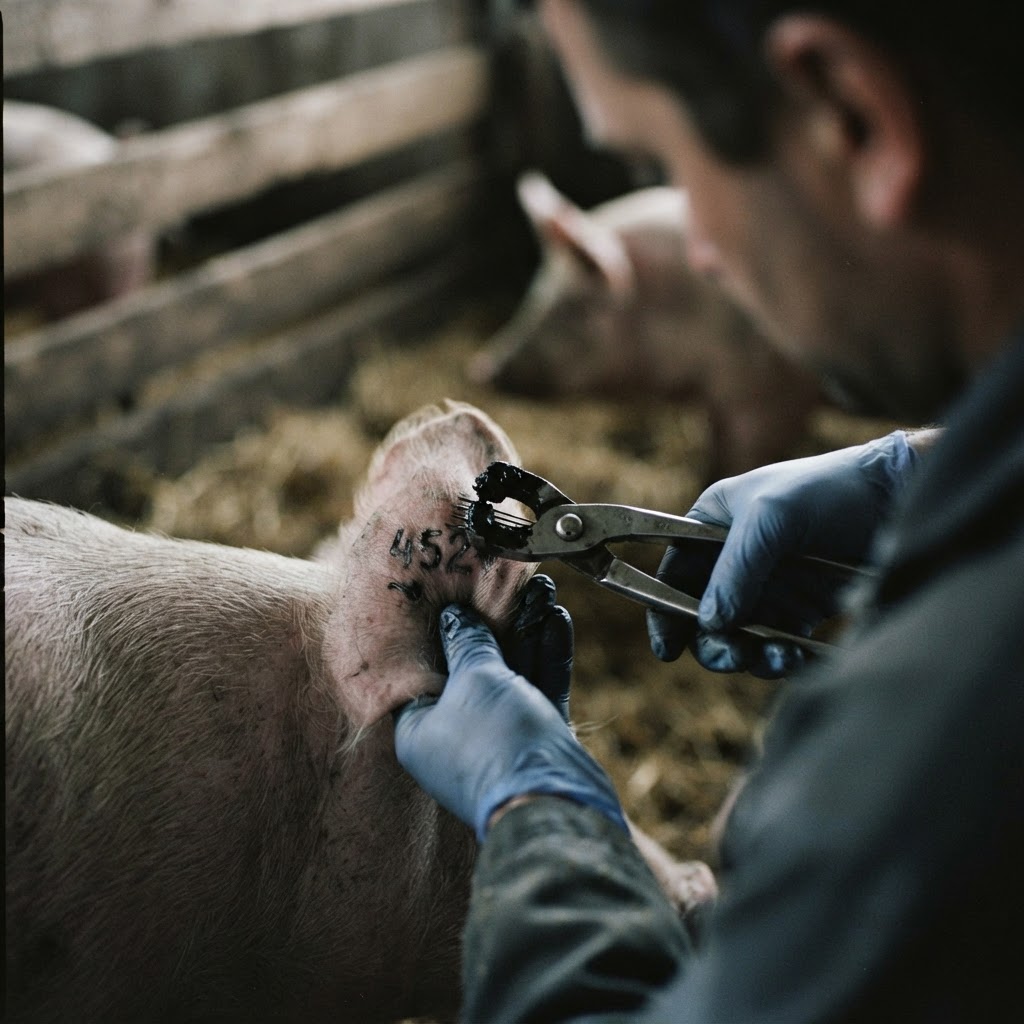
When a tag can come off, a tattoo stays. A practical guide to livestock tattooing equipment, technique, and why permanent ink identification remains the gold standard for high-value animals.
The most permanent mark in the barn
Ear tags are read at arm's length. Tattoos are read skin-to-skin. That single difference explains why tattooing has survived a century of competing technology and remains the identification method regulators and breed associations trust for the animals that matter most. A tattoo cannot fall out, cannot fade in the sun, and cannot be transferred to another animal. The mark is placed under the skin, in ink, and it stays for the life of the animal.
The trade-off is labor. Tattooing is slower than tagging and demands a steadier hand. For a thousand-head finishing group it is the wrong tool. For a registered sire, a foundation dam, a research subject, or any animal whose identity must be provable ten years from now, it is the right tool. At ORVEXAVET we build the equipment for both ends of that decision, and this article is a working field guide to the permanent-ink side.
How a livestock tattoo works
The principle is simple. A set of needle digits arranged into the desired characters is pressed into the skin — usually the inner ear or, for swine, the flank — and ink is forced into the punctures. The skin heals over the ink, locking it in place. Because the mark lives beneath the surface, ultraviolet light, friction, and weather never reach it. Readability at year ten depends almost entirely on technique at minute one.
That places the real engineering burden on three things: the plier that drives the needles, the digits that form the characters, and the ink that fills them. Each is a separate decision.
The plier
The plier must drive the needle array to a consistent depth. Too shallow and the ink sits in the epidermis and sheds out; too deep and you bruise the tissue and distort the characters. Our Livestock Tattoo Plier with Digit Sets is built around a jaw that closes parallel, which is the only geometry that delivers a clean imprint across the full width of the character set in one stroke. For animals where reach is the problem — cattle in a chute, hogs against a wall — the Long-Handle Tattoo Hammer gives you the leverage to strike a clean mark without climbing into the animal's space.
The Pig Tattoo Plier Kit is the same logic tuned for swine ears, which are thicker and more vascular than bovine ears. It ships with the digit sets sized for the application so you are not mixing and matching at the chute. And for operations that tattoo daily rather than seasonally, the Livestock Tattoo Hammer — Professional Series is the heavier-duty version, built for the wear cycle of repeated use without the jaw loosening over thousands of strikes.
The digits
Digits are the consumable that everyone underestimates. A dull or bent needle produces a mark that looks fine on day one and blurs into illegibility as it heals. The needle gauge matters: too fine and the ink does not take, too coarse and the character bleeds. Sets should be stored dry, replaced at the first sign of bending, and matched to the species. The full tattoo equipment line is organized so you can order replacement digits and pliers from a single source rather than cobbling the kit together from three vendors.
The ink
Ink is where most tattoo failures actually originate. A mark applied with thin or contaminated ink will heal faint and be unreadable within a year. The standard is a paste, not a liquid, because paste holds in the puncture long enough to set before the animal shakes it out. Our Livestock Tattoo Ink Paste — Black is formulated for the viscosity and pigment density that produce a mark that survives the healing process and stays black for the animal's life. Keep it sealed, keep it above freezing, and never dilute it. If your ink has separated in the container, it is past its service life — start a new one rather than tattooing an animal with a mark you will have to redo.
Technique, in four steps
The equipment only matters if the technique is sound. The reliable sequence is:
- Clean the site. Wax, dirt, and hair all interfere with ink uptake. A dirty ear is the number one cause of a faint tattoo.
- Load and test. Set the digits, ink the needles, and test the closure on a piece of cardboard before touching the animal. A misaligned set is a wasted mark.
- Apply firmly, once. A single clean strike beats two soft ones. Repeated strikes blur the characters.
- Rub the ink in. After the needles withdraw, work the ink into the punctures with a finger. This is the step most people skip and the one that most improves long-term legibility.
Done this way, the mark you read at the chute is the mark you will read in five years. Done carelessly, no equipment in the world will rescue it.
Why permanent identification still matters
It is fair to ask whether tattoos are still necessary in an era of RFID and electronic identification. They are, for one reason: durability of evidence. An electronic tag is an excellent device and an excellent record, but it is still a tag, and a tag can be lost, removed, or swapped. A tattoo is a mark on the animal itself. When a breed registry, a research protocol, or a disease investigation needs to prove that the animal in front of them is the animal the paperwork describes, they look for a tattoo. Regulatory animal-identification guidance from USDA APHIS Animal Health and international standards coordinated through the World Organisation for Animal Health both rest on identifiers that outlive the device. A tattoo is the identifier and the device in one.
For a deeper look at how the stamping principle transfers to visible identification, our companion piece on metal ear tags covers the stamped-metal side of the same engineering philosophy.
Choosing your kit
If you are tattooing a few registered animals a year, the plier-and-digit set is enough. If you run a research barn or a breeding operation where tattooing is a weekly task, step up to the Professional Series and keep a sealed reserve of ink paste. Either way, buy the equipment once and maintain it; the cost of the tools is trivial next to the cost of an unreadable tattoo on a valuable animal. Our standard returns policy covers any tool that does not meet spec on arrival, so the only real risk is waiting too long to standardize your kit.