Poultry Leg Bands and Wing Bands: A Field Guide to Flock Identification
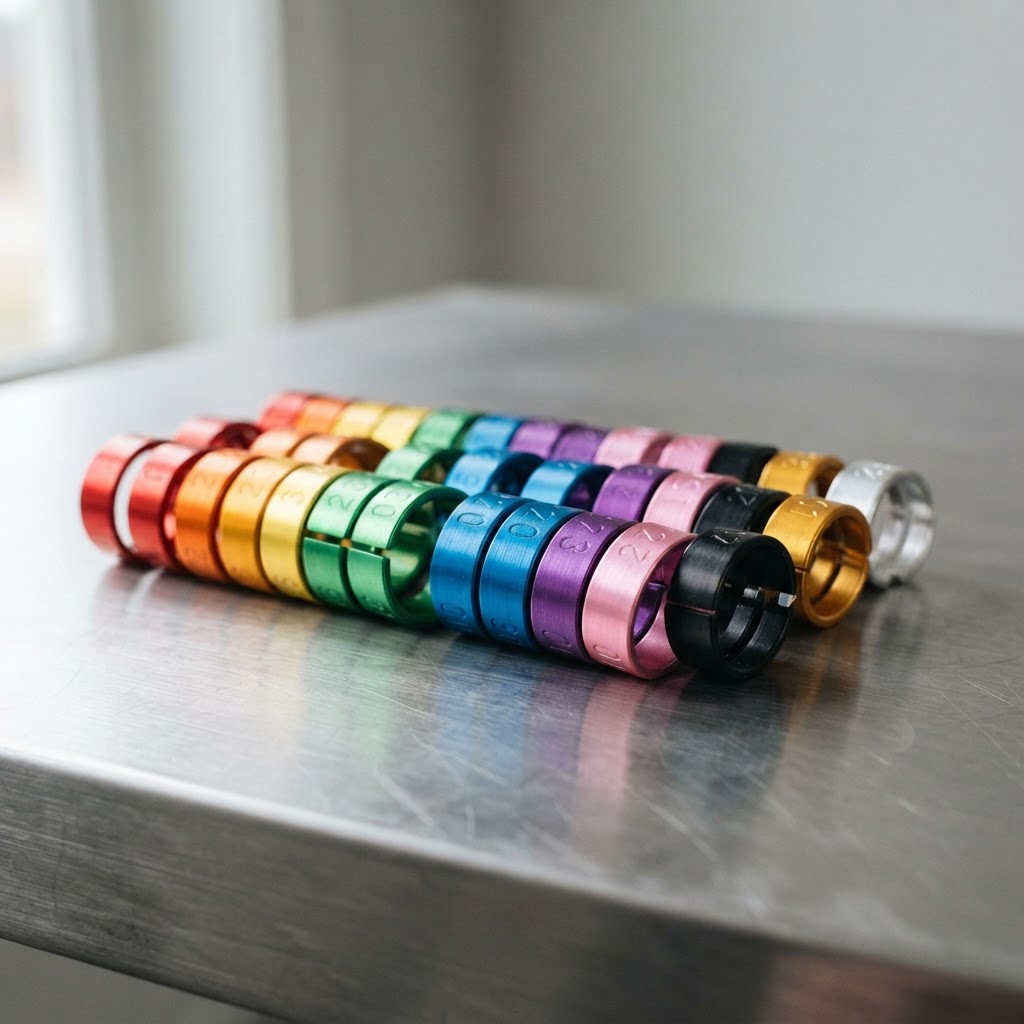
From backyard layers to commercial breeding flocks, choosing the right leg band or wing band is the difference between a record you can trust and a flock you can only guess at.
Identifying a bird is harder than identifying a cow
A bovine carries an ear tag for a decade. A chicken lives a fraction of that, moves in a group of dozens or thousands, and weighs a few hundred grams. The identification device has to scale down without becoming a joke. A band that is fine for a laying hen is useless on a turkey; a band that stays on a turkey chafes a bantam. Choosing correctly is less about brand loyalty than about matching the device to the species, the age, and the purpose of the flock.
At ORVEXAVET we carry the full range and are deliberately unbashful about telling you which one you actually need. This guide walks through the two families — leg bands and wing bands — and where each earns its place.
Leg bands: the readable, reusable standard
Leg bands sit around the lower leg and are read at a glance. They are the default for breeding and exhibition birds because they are visible, numbered, and — if you choose aluminum — durable enough to outlast the bird. The trade-off is fit. A leg band that is too loose slides and catches; one that is too tight constricts the leg. Sizing is everything.
Our Aluminum Chicken Leg Band — Colored is the working standard for layers and show birds. The color lets you sort by hatch year, bloodline, or breeding group at a distance, and the aluminum holds its number through years of dust and scratching. For waterfowl, the geometry is different: a chicken band does not seat correctly on a duck or turkey shank, which is why the Spiral Leg Band — Turkey & Duck uses a spiral form that wraps the leg and self-sizes within its range. Reach for the spiral whenever the bird is larger than a chicken or has a shank the chicken band cannot grip.
Wing bands: the permanent, lightweight mark
Wing bands solve a different problem. A leg band is removable and reusable; a wing band is permanent and single-use. A small aluminum clip is locked through the web of the wing — the thin membrane between the radial and ulna — and stays for the life of the bird. Because it weighs almost nothing and sits flat against the wing, it is the right choice for day-old chicks and for any program that needs to mark birds at hatch and never re-handle them for ID.
The Wing Band — Aluminum Poultry is built for exactly this use case. It is applied with a dedicated applicator that folds the clip closed through the web, and once closed it does not reopen. For a hatchery marking thousands of chicks, or a research flock tracking individuals from hatch, the wing band is the device that makes the record possible in the first place. Browse the complete poultry bands line to compare the two families side by side.
When to choose which
The decision collapses to three questions.
- Do you need to re-read the ID frequently? Use a leg band. It is visible without catching the bird.
- Do you need to mark birds at hatch and never touch them again? Use a wing band. It is permanent from day one.
- Are the birds large or waterfowl? Use a spiral leg band; the standard chicken band will not seat correctly.
Many serious flocks run both: a wing band at hatch for the lifetime record, and a colored leg band added at maturity for the readable, sortable tag. The two devices answer different questions and do not conflict.
The traceability angle
Poultry identification is not only a barn convenience. Avian disease surveillance and breeding-record integrity both depend on identifiers that hold up to the conditions birds live in — dust, mud, ammonia, and constant motion. National animal-health guidance is coordinated through USDA APHIS Animal Health, and the international framework sits with the World Organisation for Animal Health. A band that falls off or a number that wears smooth does not just cost you a record; it breaks the chain that lets an investigator trace a bird back to its source flock. That is why we specify aluminum rather than softer alloys and stamp rather than print wherever the application allows. The engineering reasoning is the same as in our companion piece on metal ear tags: a mark pressed into metal survives what a mark painted onto plastic does not.
Caring for bands in the field
Bands are cheap; the record they enable is expensive to rebuild. A few habits extend their service life dramatically. Keep colored leg bands sorted by year so an old band never reads as a new hatch. Check the fit of any band on the first handling after application — a bird grows, and a band that fit at eight weeks may constrict at sixteen. Replace any band that shows corrosion or deformation rather than letting it fail in the flock. And never re-use a leg band on a different bird without re-numbering it; a recycled number is worse than no number at all because it generates a false record.
Buying for the flock you actually have
The temptation is to buy one band type in bulk and force it onto every bird. Resist it. A mixed flock — layers, a few turkeys, a breeding pen — is better served by three small orders of the right devices than one large order of the wrong one. Our poultry lines are priced so that buying the correct device for each group is not a budget problem, and our returns policy covers any band that does not fit the birds you are applying it to. Start by counting your birds by species and age, then match each group to its device. That is the entire method, and it is the difference between a flock you can account for and a flock you can only estimate.